

REFLECTION
To evaluate the user experience, I conducted usability testing sessions with real users using the high-fidelity prototype. The goal was to observe user behavior, identify friction points in core user flows, and ensure the interface is intuitive and easy to navigate.
Reflection Section
It was challenging to build an app that lets people book grounds quickly and find local players to play with. I learned how to make the 3-tap booking super fast without hiding important details like player skill levels and host safety info.
Personal Growth as a Designer
Overcoming Design Challenges
Future Improvements
It was challenging to build an app that lets people book grounds quickly and find local players to play with. I learned how to make the 3-tap booking super fast without hiding important details like player skill levels and host safety info.
If I had more time, I would design a "Waitlist & Auto-Refund" feature for full matches, and add skill-based badges to help players find matches that fit their level.
All Projects
CHALLENGE
Pain Points
Manual & Fragmented Bookings:
Players rely on time-consuming phone calls and WhatsApp chats with ground owners, leading to delayed confirmation and a tedious manual process.
Lack of Real-Time Availability:
Without a live slot view, players face double-bookings, sudden slot cancellations, and friction during advance payment transfers.
Last-Minute Squad Shortages:
Solo players or incomplete teams struggle to find nearby players on short notice for full matches (e.g., 11v11 cricket or badminton doubles).

RESEARCH
Rise of Turf Culture: Turf sports have seen exponential growth, making quick and instant slot booking a daily requirement for players.
Diverse User Base: The target audience ranges from casual weekend players to competitive group organizers requiring instant confirmation without phone calls.
Market & User Context
Connecting with
Users.
Secondary Research
User Survey
User Interviews
Competitive & Heuristic Audit
Identifying Core Pain Points
Opaque Availability: Existing local turf platforms and manual call systems lack real-time slot views, forcing users to make multiple calls to confirm
a single game.
Cluttered Interfaces: Existing booking apps overwhelm users with unnecessary promotions instead of focusing on a quick 3-tap booking flow.
Manual Coordination Fatigue: Group captains waste hours on WhatsApp groups trying to collect player confirmations and split payments manually.
Uncertain Slot Locking: High friction and lack of instant confirmation during peak weekend slots often lead to last-minute booking cancellations.
Player Shortages: Individuals or small groups struggle to complete team counts (e.g., needing 2 more players for a match) without a dedicated community hub.
Through primary and secondary research, we gathered key insights on player preferences and ground booking friction points. Through this data, we were able to establish foundational understandings of our target audience's core challenges.



Analyzed Play Store reviews of local turf booking apps and Google Maps feedback to identify common complaints regarding double-bookings and unverified slots.
Gathered quantitative data from regular ground bookers and players to understand booking frequency, preferred time slots, and payment habits.
Conducted 1-on-1 discussions with active players and turf managers to uncover booking bottlenecks, team-coordination issues, and payment friction.
Key Findings from Research
INSIGHTS
User Personas
I created two personas to get a better understanding of the types of users, their goals, and frustrations. Personas were created from the types of users that I interviewed (people of different ages).
Rahul Sharma is a 26-year-old software engineer who needs a fast, transparent way to check live ground availability and lock slots instantly, because he wastes hours making manual phone calls and running the risk of double-bookings for his weekend cricket matches.
Problem Statement (Rahul):
Priya Nair is a 23-year-old UX intern who needs a safe and reliable way to discover local sports matches nearby, because she recently moved to a new city and lacks a sports network to find active badminton games with compatible skill levels.
Problem Statement (Priya):
If Groundly provides an open squad-matching feed with skill-level indicators and verified host profiles, then Priya will seamlessly join local matches near her apartment without safety or privacy concerns.
Hypothesis Statement (Priya):
If Rahul can view real-time venue schedules and lock a slot in a 3-tap booking flow with 1-tap WhatsApp squad invites, then he will complete ground bookings 3x faster without coordination drop-offs.
Hypothesis Statement (Rahul):
Problem & Hypothesis Statements

GOALS
Description: Streamline the end-to-end ground booking journey so that users can view real-time slot availability and lock a ground in under 60 seconds without cognitive overload or manual phone calls.
Why it matters: Ground bookers (like Rahul) waste significant time on phone calls and WhatsApp chats checking slot availability, leading to drop-offs and double-bookings.
Minimize Booking Friction & Time
Simplify Squad Creation & Match Discovery
Streamline Payment & Squad Invites
Description: Provide a transparent, open squad-matching feed that allows players to easily discover nearby open games, check player skill levels, and send instant join requests.
Why it matters: Solo or new-in-town players (like Priya) lack local sports networks and struggle to find reliable, compatible matches near their location.
Description: Enable an effortless checkout experience with pre-filled payment modes and single-tap WhatsApp match invite sharing for instant group coordination.
Why it matters: Last-minute booking decisions rely on quick slot locking and instant team confirmation before slots get taken by others.
Goal statements define how the platform will address users needs and how we will measure the impact of these solutions.
Design Objectives

PROCESS
Research & Analysis: Conducting user interviews with local players, analyzing competitor apps, and identifying key friction points in manual
turf bookings.
Define & Strategy: Developing target proto-personas, establishing core product goals, and defining the value proposition for a 0-to-1 sports booking experience.
Ideation & Architecture: Mapping out the 4-row User Flow, structuring the Information Architecture (IA), and sketching low-fidelity layouts.
UI & Prototyping: Building a scalable design system, crafting 30+ high-fidelity screens, and creating interactive user journeys.
Testing & Evaluation: Conducting internal usability walkthroughs of the core payment path and mapping edge cases for seamless app functionality.
By using the Design Thinking methodology, I focused on understanding the needs of users and applied what I learned throughout the process to the project.

ARCHITECTURE
Information Architecture (IA) organizes content so users can easily navigate and find what they need. A site map visualizes this structure, showing how pages and features are connected.

USER FLOW
A user flow visualizes the journey a user takes within the project. It outlines each step from the entry point to the final interaction, helping to understand how users navigate and complete their goals seamlessly.

WIREFRAME
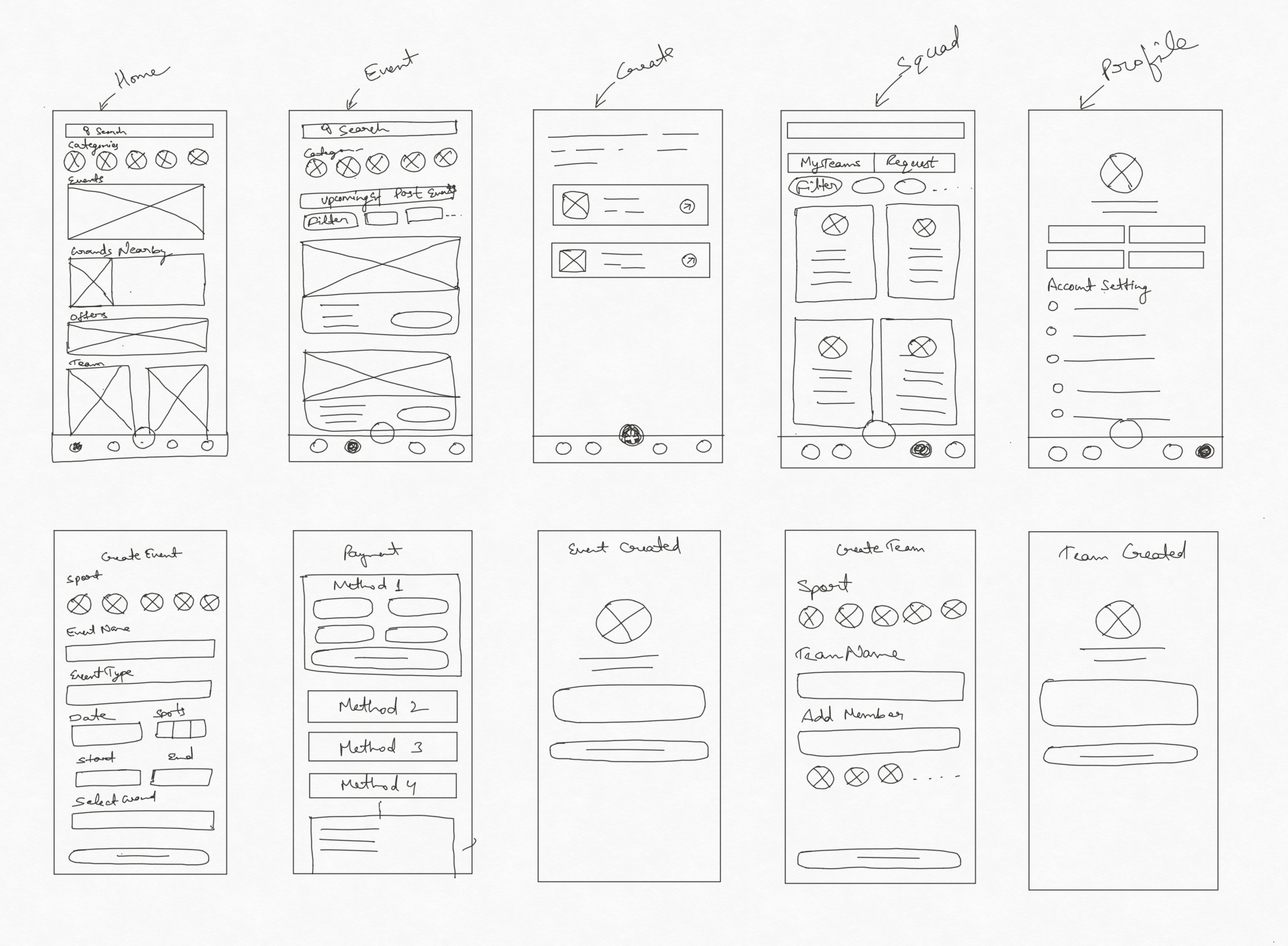
Low Fidelity Wireframe highlights structure and interactions, helping refine usability before moving to final designs.

INTERFACE
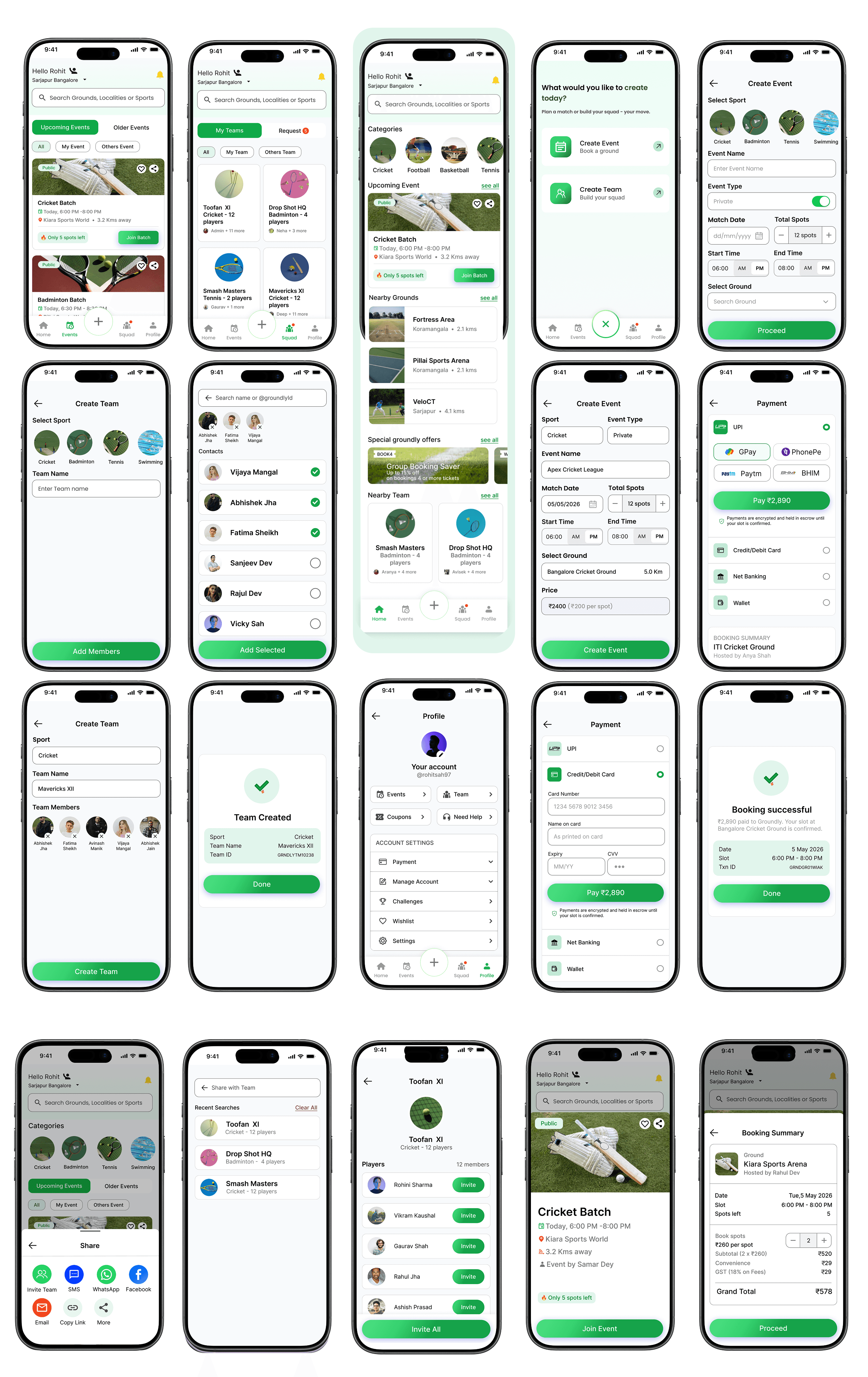
Mid Fidelity Wireframe highlights structure and interactions, helping refine usability before moving to final designs.

GROUNDLY
Designing a Seamless Ground Booking App
Overview
Groundly is a sports platform designed to simplify local ground bookings and community match-making. This project crafts an intuitive mobile experience with live slot availability, fast checkouts, and instant squad creation.
To eliminate manual phone calls and fragmented sports groups, making turf bookings 3x faster while helping local players easily find and join nearby games.
My role within this project was the end-to-end Product Designer, responsible for user research, information architecture, wireframing, design system creation, and high-fidelity prototyping.
ROLES
UI Designer
User Research
Prototyping
TIMELINE
8 Weeks
TOOLS
Figma
FigJam
Illustrator


Designing a Seamless Ground Booking App
Overview
Groundly is a sports platform designed to simplify local ground bookings and community match-making. This project crafts an intuitive mobile experience with live slot availability, fast checkouts, and instant squad creation.

ROLES
UI Designer
User Research
Prototyping
TIMELINE
8 Weeks
TOOLS
Figma
FigJam
Illustrator
Challenge
Pain Points
Manual & Fragmented Bookings:
Players rely on time-consuming phone calls and WhatsApp chats with ground owners, leading to delayed confirmation and a tedious manual process.
Lack of Real-Time Availability:
Without a live slot view, players face double-bookings, sudden slot cancellations, and friction during advance payment transfers.
Last-Minute Squad Shortages:
Solo players or incomplete teams struggle to find nearby players on short notice for full matches (e.g., 11v11 cricket or badminton doubles)
Research
Through primary and secondary research, we gathered key insights on passenger preferences and booking friction points. Through this data, we were able to establish foundational understandings of our target audience's core challenges.

Secondary Research
User Survey
User Interviews
Key Findings from Research
Market & User Context
Rise of Turf Culture: Turf sports have seen exponential growth, making quick and instant slot booking a daily requirement for players.
Diverse User Base: The target audience ranges from casual weekend players to competitive group organizers requiring instant confirmation without phone calls.
Competitive & Heuristic Audit
Opaque Availability: Existing local turf platforms and manual call systems lack real-time slot views, forcing users to make multiple calls to confirm a single game.
Cluttered Interfaces: Existing booking apps overwhelm users with unnecessary promotions instead of focusing on a quick 3-tap booking flow.
Identifying Core Pain Points
Manual Coordination Fatigue: Group captains waste hours on WhatsApp groups trying to collect player confirmations and split payments manually.
Uncertain Slot Locking: High friction and lack of instant confirmation during peak weekend slots often lead to last-minute booking cancellations.
Player Shortages: Individuals or small groups struggle to complete team counts (e.g., needing 2 more players for a match) without a dedicated community hub.
Insights
I created two personas to get a better understanding of the types of users, their goals, and frustrations. Personas were created from the types of users that I interviewed (people of different ages).
Problem & Hypothesis Statements
Problem Statement (Rahul):
Rahul Sharma is a 26-year-old software engineer who needs a fast, transparent way to check live ground availability and lock slots instantly, because he wastes hours making manual phone calls and running the risk of double-bookings for his weekend cricket matches.
Hypothesis Statement (Rahul):
If Rahul can view real-time venue schedules and lock a slot in a 3-tap booking flow with 1-tap WhatsApp squad invites, then he will complete ground bookings 3x faster without coordination drop-offs.
Problem Statement (Priya):
Priya Nair is a 23-year-old UX intern who needs a safe and reliable way to discover local sports matches nearby, because she recently moved to a new city and lacks a sports network to find active badminton games with compatible skill levels.
Hypothesis Statement (Priya):
If Groundly provides an open squad-matching feed with skill-level indicators and verified host profiles, then Priya will seamlessly join local matches near her apartment without safety or privacy concerns.
Goals
Goal statements define how the platform will address users needs and how we will measure the impact of these solutions.
Design Objectives
Minimize Booking Friction & Time
Description: Streamline the end-to-end ground booking journey so that users can view real-time slot availability and lock a ground in under 60 seconds without cognitive overload or manual phone calls.
Why it matters: Ground bookers (like Rahul) waste significant time on phone calls and WhatsApp chats checking slot availability, leading to drop-offs and double-bookings.
Simplify Squad Creation
Description: Provide a transparent, open squad-matching feed that allows players to easily discover nearby open games, check player skill levels, and send instant join requests.
Why it matters: Solo or new-in-town players (like Priya) lack local sports networks and struggle to find reliable, compatible matches near their location.
Streamline Payment & Squad Invites
Description: Enable an effortless checkout experience with pre-filled payment modes and single-tap WhatsApp match invite sharing for instant group coordination.
Why it matters: Last-minute booking decisions rely on quick slot locking and instant team confirmation before slots get taken by others.
Process
By using the Design Thinking methodology, I focused on understanding the needs of users and applied what I learned throughout the process to the project.
Research & Analysis: Conducting user interviews with local players, analyzing competitor apps, and identifying key friction points in manual
turf bookings.
Define & Strategy: Developing target proto-personas, establishing core product goals, and defining the value proposition for a 0-to-1 sports booking experience.
Ideation & Architecture: Mapping out the 4-row User Flow, structuring the Information Architecture (IA), and sketching low-fidelity layouts.
UI & Prototyping: Building a scalable design system, crafting 30+ high-fidelity screens, and creating interactive user journeys.
Testing & Evaluation: Conducting internal usability walkthroughs of the core payment path and mapping edge cases for seamless app functionality.
Architecture
Information Architecture (IA) organizes content so users can easily navigate and find what they need. A site map visualizes this structure, showing how pages and features are connected.

User Flow
A user flow visualizes the journey a user takes within the project. It outlines each step from the entry point to the final interaction, helping to understand how users navigate and complete their goals seamlessly.

Wireframes
Low-fidelity wireframes clarified layout, interactions, and hierarchy before high-fidelity interface design began.
Interface
High fidelity mockup shows the final look of the app with real colors, clear fonts, and actual images. Every screen is designed using standard iOS guidelines to make sure the app looks beautiful, modern, and easy for everyone to use.
Reflection
To evaluate the user experience, I conducted usability testing sessions with real users using the high-fidelity prototype. The goal was to observe user behavior, identify friction points in core user flows, and ensure the interface is intuitive and easy to navigate.
Personal Growth as a Designer
It was challenging to build an app that lets people book grounds quickly and find local players to play with. I learned how to make the 3-tap booking super fast without hiding important details like player skill levels and host safety info.
Overcoming Design Challenges
It was challenging to build an app that lets people book grounds quickly and find local players to play with. I learned how to make the 3-tap booking super fast without hiding important details like player skill levels and host safety info.
Reflection Section
Future Improvements
If I had more time, I would design a "Waitlist & Auto-Refund" feature for full matches, and add skill-based badges to help players find matches that fit their level.
All Projects